Roof Systems
Built-Up Roofing in Nampa, ID
Built-up (BUR) roofing in Nampa, ID: core sampling, ply counts, surfacing review and repair limits for gravel-surfaced multi-ply roofs on commercial buildings.
Built-Up Roofing
A core cut from the roof, labeled and photographed, settles more questions about a built-up roof than a walk-over can. A BUR assembly is several plies of felt or fabric sheet mopped together with hot asphalt and finished with gravel, a cap sheet or a coating, and the only way to count the plies and see the condition of the asphalt between them is to take a small sample from the surface to the deck.
For a building in Nampa, ID, a BUR scope begins with that sample. We cut, photograph, patch the cut, and record the roof section, the ply count, the presence of moisture and the thickness of the insulation. Everything else in the scope follows from those entries.

Plies, Asphalt and Surfacing
The strength of a BUR roof comes from redundancy. Each ply is bonded to the next by a full mopping of asphalt, so a defect in one sheet is covered by the sheets above and below it. The top surface is protected by embedded gravel, a mineral-surfaced cap sheet, or a reflective coating that shields the asphalt from sunlight.
As the asphalt ages, it oxidizes and loses flexibility. Alligatoring, a pattern of shallow cracks in the surface bitumen, appears when the protective layer is gone. We record the extent of cracking and the loss of gravel by roof section, because a bare patch the size of a parking space is a different decision than a few exposed inches at a drain.
Aging Signs in the Field
Four conditions repeat on older built-up roofs. Blisters appear where trapped moisture or air has lifted the plies. Ridges form over insulation joints. Flashings pull away from walls as the roof moves. Gravel migrates to drains and clogs them. Each is photographed in place with a tape or a marker in the frame for scale.
None of these conditions proves the roof has failed, and none can be dismissed on sight. A blister that is dry and intact can sit for years. A blister that has split lets water reach the felts and the insulation below. We probe the area gently, note whether the plies are soft, and add the location to the moisture survey plan.
Because the Treasure Valley carries most of its yearly precipitation between November and May, an aging BUR is best walked twice, once in fall and once in spring. The fall walk clears gravel from drains before the first storm, and the spring walk looks for splits that opened during freeze-thaw cycles.
Moisture Mapping Before Decisions
A built-up roof hides water well. The asphalt and gravel hold heat during the day, and moisture in the insulation can sit for years without a stain on the ceiling. An infrared moisture survey run at dusk, when the wet areas release heat more slowly than dry ones, shows the pattern across the roof, and core samples confirm it at selected points.
The mapped boundary becomes the repair limit. Dry areas can be recoated or repaired, and wet areas are cut out and replaced. If wet insulation spreads across a large share of the roof, the question is whether a full replacement is cheaper than the sum of the patches, and the survey figures belong in the file beside the quote.
Weight and Design Load
A gravel-surfaced BUR is heavy, and the structure carries it. Adding a new roof over an old one, or adding equipment, needs a structural check against the city's roof load floor of 25 pounds per square foot and its ground snow figure of 20 pounds. We list the existing assembly weight from the core sample and the proposed assembly weight next to it, and we flag the difference.
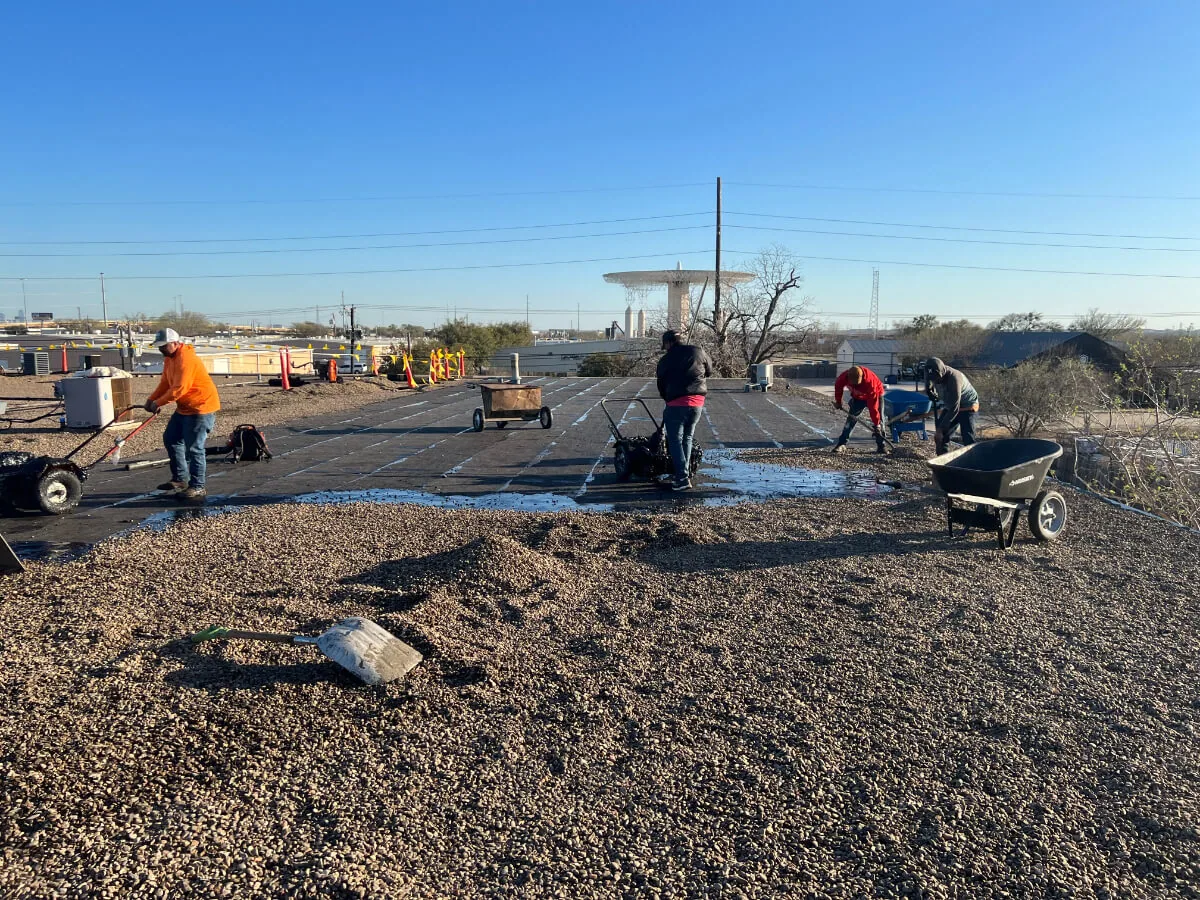
Tear-off of a gravel roof also generates debris and dust, and the removal plan covers where gravel is stored, how drains are protected and how the roof is cleaned before the new membrane is laid. Work over an occupied space needs protected walkways and a schedule for noisy tasks.
Industrial and Commercial Buildings
Nampa's plans describe industrial activity in the east quadrant south of I-84 and north of the railroad, and the railroad forms the boundary between that quadrant and the south quadrant. Along the Nampa rail corridor, a long-lived roof like BUR is a practical answer for owners who plan to hold a building for decades, and a warehouse roof is a candidate for a multi-ply assembly if the deck can carry it.
Where a building already has a BUR, a recover with a newer membrane is sometimes possible. The recover over the existing roof depends on the moisture survey, the attachment of the old plies and the loads described above. A recover over wet insulation is not a recover, it is a delay.
The land between I-84 and the Boise River is where the city plan describes large industrial tracts. For an owner there with a multi-ply roof, the first question is whether it still has sound plies under the surfacing, and if so, how many seasons of service remain before the capital plan needs a number.
BUR Compared With Newer Systems
Many owners replace BUR with single-ply sheets such as TPO because the labor is faster, the hot asphalt is avoided and the weight drops. Others move to modified bitumen, which keeps a multi-ply feel with a more flexible asphalt. A few stay with BUR for its record of long service and its tolerance for foot traffic.
We write the comparison in terms the building controls: deck type, load capacity, penetration count, traffic and the capital plan. A roof capital plan that puts the replacement year next to the repair cost to date lets an owner decide on numbers instead of on the age of the roof alone.
Closeout File
The file holds the core sample photographs, the ply count and thickness, the moisture map, the product data for any new layers, the flashing photographs and the follow-up date. If a section was repaired, the boundary is drawn on the roof plan with the date and the repair method, which allows the next inspection to compare conditions without guesswork.
A built-up roof that has been cored once should not need to be cored again at the same spot. The closeout plan marks each cut location, so a later sample is taken a few feet away, and the roof is not weakened by repeated holes in one area.
Questions
How many plies does my roof have?
A core sample answers it. The cut is made at a low-risk spot, the layers are counted and photographed, and the cut is patched the same day. The count goes on the roof plan.
Is a blister on a BUR roof an emergency?
A dry, unbroken blister is a monitored item. A split blister, or one over a damp ceiling, is repaired promptly. The sample and photograph decide which it is.
Can gravel be left in place during a recover?
Usually it is removed or swept, since loose stone damages a new membrane. A cover board may go over a smooth surface, and the substrate is checked for flatness first.
Why does a BUR roof need a structural check before a new layer?
Because it is already one of the heavier assemblies. The existing weight, the new weight and the design load are compared on paper before any material is ordered.
What does the closeout file record?
The ply count, the moisture map, product data, flashing photographs and the follow-up date, so a later repair can be matched to what was built.