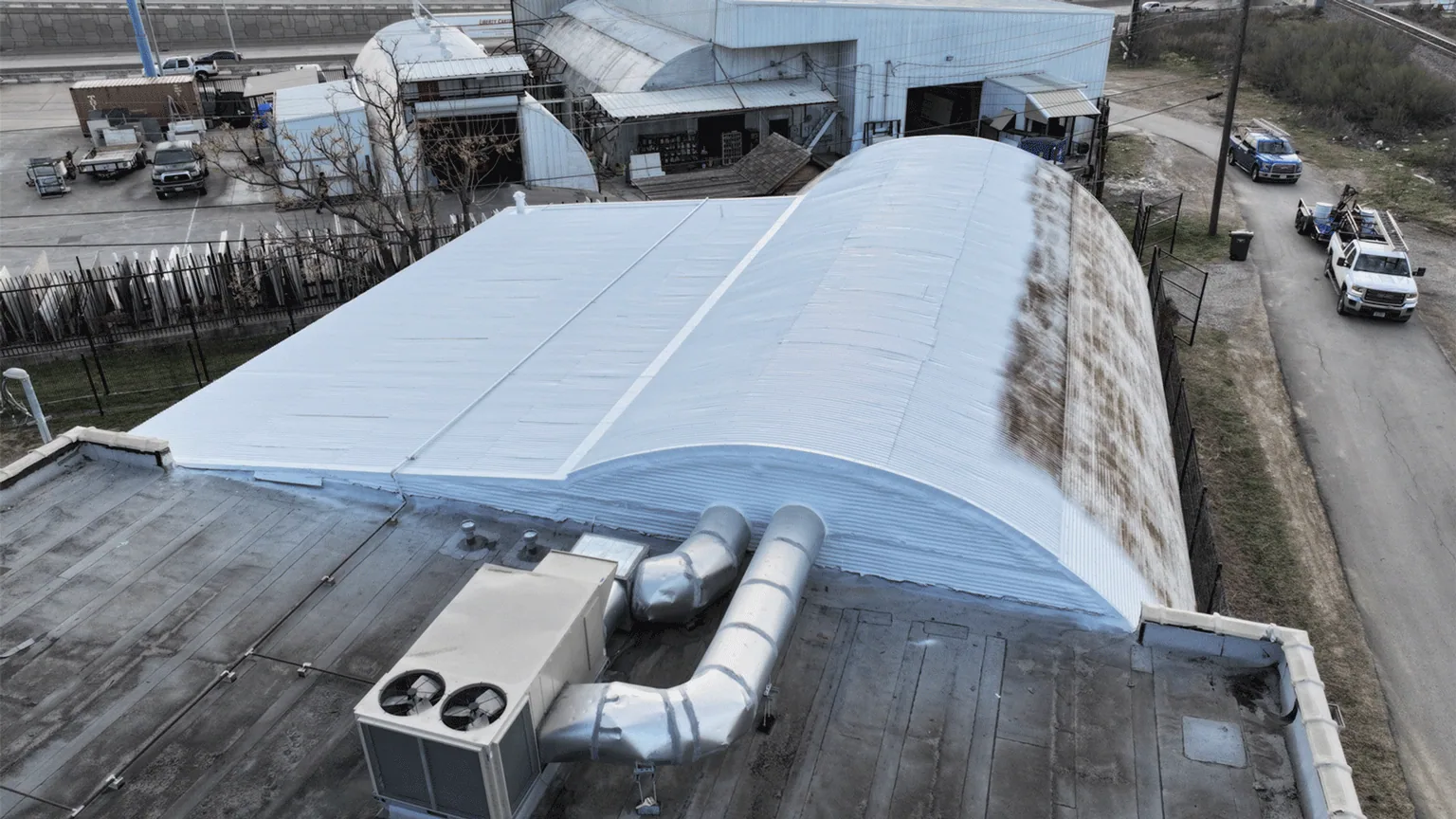
Commercial Roofing Services
Commercial Roof Leak Repair in Nampa, ID
Tracing and stopping active commercial roof leaks in Nampa, ID, using a leak log, moisture mapping, and water testing before any repair is priced.
Commercial Roof Leak Repair
A leak report is only useful with a date, a room, and the weather that day. Rain in July, snowmelt in February, and a drip that appears only after the heating cycle starts all point to different parts of the roof, and a facility manager who writes those details down on the first call saves hours of searching later. We start every leak call with that log, because the pattern of when water appears is the first piece of evidence about where it enters.
On a commercial roof in Nampa, ID, the opening in the membrane is often several feet from the stain, since water travels along decking, insulation boards, and ductwork before it reaches a ceiling tile. The job is to trace it back to the entry point with measurements, then stop it with a repair sized to the cause.
Leak Log
The log is a short table: date and time the water was seen, the room and ceiling location, what the weather had done in the prior day, whether the building heating or cooling was running, and any earlier leak at the same spot. The pattern narrows the search. Water that shows only after sustained rain suggests a field or seam opening. Water that appears with wind suggests a flashing or edge. Water that shows on a cold, dry morning points to condensation or snowmelt held against a drain.
We ask for photographs of the interior stain with a tape or familiar object for scale and a plan of the roof if the owner has one. If none exists, we sketch one on the first visit and label each section so the leak log, the survey findings, and the repair all share the same section numbers.
Tracing Method
Tracing begins on the roof with a visual walk of the area above and upslope of the interior stain, since water moves downhill along the deck before it drops. We look at the nearest penetrations, curbs, drains, seams, and edge metal, and we probe seams and flashing terminations with a blunt tool to find laps that have opened. Where the cause is not visible, an infrared moisture survey or a nuclear or capacitance meter pass maps wet insulation, and the wet area's edge often points to the entry point.
The scope is written from the findings, not from the stain. If the survey shows the wet area is limited to one section, the repair stays local. If it shows wet insulation reaching across the section, the file says so and the owner can weigh a larger repair against a planned repair program.
Controlled Water Testing
When tracing leaves two or three suspects, a controlled water test separates them. A crew wets one area at a time, starting at the lowest suspect and working upslope, with an observer inside the building and a pause between each area long enough for water to travel. The test is logged by time and location, so the first interior drip is matched to the exact area being wet. This keeps a leak from being blamed on a flashing that was dry the whole time.
Testing is useful at roof-to-wall junctions and around curbs where several details meet. A failed flashing and a hairline split in the adjacent membrane can look alike from above, and the water test shows which one admits water. We stop the test the moment the leak reproduces, mark the location, and photograph it before any repair begins.
Interior Protection and Tenant Contact
While the roof search proceeds, the interior needs attention. Water collecting above a ceiling tile can release all at once, so the first visit includes opening a tile or two to relieve the pocket, placing containment under the drip, and moving stock or electronics out of the path. The facility manager receives a short condition note with photographs of what was found above the ceiling, which also helps an insurer understand the damage.
In multi-tenant buildings the tenant whose suite is wet is rarely the tenant whose lease covers the roof, so we keep a contact list in the file: who reports the leak, who authorizes access, and who needs a copy of the findings. Roof access through a suite or a locked mechanical room is scheduled in advance, and the crew carries nothing across a sales floor without protection. Those details seem small, but they decide whether a repair takes one visit or three.
Temporary Stop and Permanent Repair
The first repair is often temporary: a sealed patch, a reinforced mastic, or a strip of membrane that holds until the weather allows a permanent fix. We label it temporary in the file and give a return date, so no temporary patch sits unnoticed for years. If water is active inside the building, the first visit also covers interior protection and the emergency response options when the roof cannot wait.
The permanent repair removes the failed detail and rebuilds it. For a modified bitumen roof, that can mean heat-welded patch and new flashing plies; for single-ply, a clean weld or new termination. Where the leak entered through ponding water, the permanent repair may include drain work or tapered insulation so the same low spot does not return.
Snowmelt and Seasonal Leaks
Winter inversions and snow cover can leave valley sites colder than the Boise airport readings, and the city sets a 10 degree Fahrenheit winter design temperature. Snow that melts during the day and refreezes at night creates ice at drains and roof edges, and the resulting dam pushes water beneath laps and into flashing terminations that stay dry in rain. A snow and ice leak usually appears days after the thaw, which is why the log records weather for the previous three days.
For buildings along Caldwell Boulevard and in Downtown Village, where the west quadrant plan notes commercial development beside older residential neighborhoods, an interior drip after a thaw can trace to a parapet or drain, and we check those first.
Questions
Why does water appear far from the roof opening?
Water follows the deck, the insulation joints, and ductwork before it drops. Tracing starts upslope from the stain and uses moisture mapping to find the wet area's edge, which points back toward the entry.
What should the first call include?
The date, the room, the weather in the previous day, and a photograph of the stain with something for scale. Those four items usually cut the search area in half before the crew is on the roof. If no plan exists, the crew sketches one on the first visit and numbers each roof section so the log and the repair use the same labels.
Is a water test always needed?
No. A test is used when tracing leaves two or three suspects that look alike. The wet area is tested one at a time, upslope from the lowest suspect, with an observer inside logging the first drip.
Will a temporary patch hold through winter?
Some do and some do not. Cold and moisture limit adhesion, so we label winter patches temporary and set a return date for a permanent repair once the surface is dry.
How is a leak repair documented?
The file holds the leak log, the survey or test findings, before and after photographs of the repair, and the follow-up date. If the same spot leaks again, the file shows what changed.