Service Areas
Commercial Roofing on Caldwell Boulevard, Nampa, ID
Roof inspection, edge and wind repair, insurance documentation, and occupied-building reroofing for businesses on Caldwell Boulevard in Nampa, ID.
Caldwell Boulevard
A corridor study looks at land use, access, and circulation, and none of those words describe a roof, which is why an owner on Caldwell Boulevard needs a roof file of their own. The west quadrant plan identifies commercial development along the boulevard and treats it as a named edge of the quadrant, and the city's planning references include a Midland Boulevard Corridor Study for the west side. Those documents guide streets and land use. The condition of a particular roof in Nampa, ID is established on the roof, with a tape, a probe, a camera, and a dated record.
Our work along the boulevard therefore starts at the roof hatch or ladder, not in a plan room. We number the sections, photograph the drains and edges, and write down what each part of the roof shows. If an owner supplies earlier invoices or a warranty, we compare them with what we find.
Business Roofs on an Active Boulevard
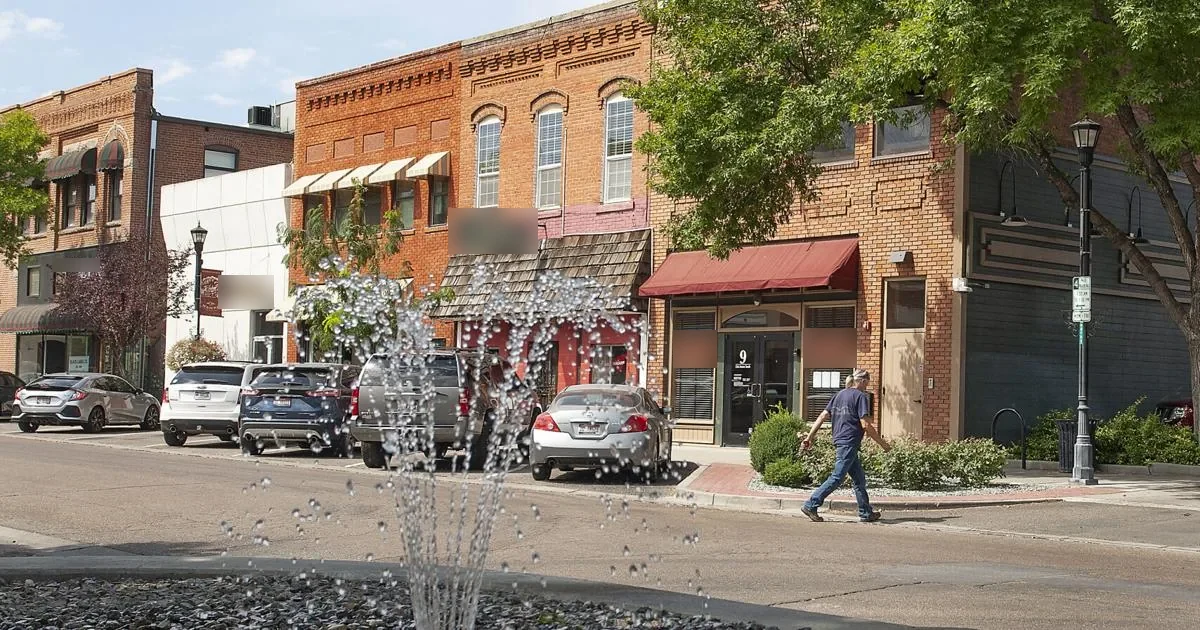
The plan does not list the building types on Caldwell Boulevard, so the first question is always the use: office, retail, service, or something else. The use determines the exposure. A roof over an office has air handlers and a conditioned interior. A roof over a retail space has signage supports and a public entrance below the edge. A roof over a service building may carry exhaust fans and vent stacks.
Each of those uses brings a different set of penetrations and a different tolerance for interruption. We build the roof plan to show them, then rank repairs by how much water each could admit. An office building roof with a leaking curb over a server room moves to the top of the list. A cosmetic edge repair moves to the bottom.
Flashing Findings at Walls and Curbs
Most leaks on a commercial roof begin at a joint between the membrane and something else. Where the membrane meets a wall, a curb, a pipe, or a skylight, flashing has to bridge two materials that move at different rates. We probe each termination with a blunt tool, lift the edge of the sealant where it looks tired, and photograph the base of the flashing from low and high angles. A bead of sealant that has pulled away from the substrate is recorded with its length.
Repairs at these joints are specific. A termination bar may need new fasteners and a new sealant bead. A corner may need a pre-formed boot in place of field-cut membrane. A wall flashing may need to be raised to clear the height of standing snow. Each is listed with the roof section number, so the invoice and the file refer to the same places.
Edge Metal, Coping, and Wind
Wind is figured at 115 mph ultimate in the city criteria, with no special wind region and no debris zone to design for. On any commercial roof, the perimeter takes the first uplift, so the edge metal, the coping, and the outer fastener rows are checked with care. We pull on loose edge metal by hand, probe the sealant at joints, and photograph any gap between the metal and the wall.
Loose edge metal is a repair even when it does not leak, because it can peel in a gust and take membrane with it. The edge metal and coping scope lists each run by length and condition. After a gust or a storm, a wind damage repair visit records what moved, what lifted, and what is still secure.
The valley gets over three quarters of its moisture in the cold half of the year, and the winter design temperature the city uses is 10 degrees. For a roof, that translates into a short winter checklist: confirm the drains are clear before the first snow, look at the gutters and downspouts for ice, and photograph any edge where meltwater refreezes. A section that shows ice at the same spot after each thaw points to a drainage problem or heat loss through the roof, and the record flags it for follow-up in spring.
Documentation for Insurance
When a storm damages a roof, the insurer asks for evidence that the condition is new. A dated photo sequence from before the event is the strongest evidence an owner can hold. We provide that record to owners who ask, and after an event we add the new photographs, the date and time of the storm, and a description of what changed.
If a claim is filed, our roof insurance claim documentation sets out the damage by section, the temporary measures taken, and the scope for permanent repair. We do not decide coverage, and we do not promise an outcome. We supply the physical record the claim rests on.
Reroofing While Businesses Stay Open
A business that keeps its doors open during roof work needs a plan that sequences the tear-off by section, keeps the customer entrance clear, and closes each section watertight at the end of every day. We agree the sequence with the owner before the work begins, including noisy hours, delivery times, and the paths the crew will use.
For the details, our plan for occupied building reroofing covers interior protection, safe pedestrian routes, and the staging of materials. If the building has a tenant with particular needs, such as a medical or food use, we ask about them in advance and set the work around them.
The West-Side Context
Caldwell Boulevard is one edge of the west quadrant, which also holds Downtown Village and historic residential neighborhoods. Owners on the boulevard may share a block with neighbors who are building or renovating, and that is why the pre-work photographs matter. They are also useful to owners in West Nampa more broadly, and to those near the Midland corridor, where the city's corridor study is a reminder that land use and access can change.
None of that changes the roof, but it can change who has access to it, how drainage is shared, and whether debris falls on it. A dated file answers those questions when they arise.
Closeout File
The owner receives a closeout file with the roof plan, before and after photographs, test results, repair limits as completed, and a follow-up date. A commercial roof inspection a year later is compared against it, section by section.
Questions
Does a corridor study change what the roof needs?
Not directly. A study guides streets and land use, while the roof needs depend on its membrane, drainage, and age. The study is a reason to hold a current roof file, since access and neighbors may change.
What evidence helps most after a windstorm?
A dated set of photographs from before the event, plus new photographs of the same positions afterward. The comparison shows what changed and removes arguments about whether damage was already there.
How do you keep a customer entrance clear during reroofing?
We sequence the work so that the section above the entrance is done outside business hours or protected with overhead covers. The path for crews and materials is separated from the path for customers.
Will you tell me whether a claim will be paid?
No. Coverage is the insurer's decision. We supply the physical record: location of damage, photographs, temporary measures, and the permanent repair scope.
How soon should loose edge metal be repaired?
As soon as it is found. Loose metal can move in the next gust, and once it lifts, the membrane under it can tear. A small refastening usually costs less than the repair that follows a peel.