Industries We Serve
Roofing for Logistics and 3PL Operators in Nampa, ID
Roof repair and replacement for logistics and 3PL operators in Nampa, ID, planned around dock schedules, racking, and inventory with dated condition records.
Logistics and 3PL Operators
Stored product sets the cost of a roof leak in a distribution building, and the roof section above that product sets the order of repair. Logistics and third-party logistics operators in Nampa, ID lease or own buildings where racks stand under the deck, where aisles run to the dock doors, and where a single drip can reach a pallet that belongs to a client. Our first task on such a roof is to match the roof sections to the inventory zones below, so the owner knows which area carries the most exposure and which can wait for the next dry window.
The roof file follows the operation. Each section is numbered, each drain and curb is photographed, and each repair is logged with the aisle or bay it protects. A warehouse manager reading the file sees the building the way the floor sees it. Where a client audit requires proof that a leak did not touch stored goods, the dated photographs and the section numbers give the operator an answer in the client's terms.
Interstate Access and Building Stock
Nampa lies roughly 20 miles from Boise on I-84, and the 2040 plan names seven overpass connections to the interstate, including Karcher Road, Franklin Avenue, and Garrity Boulevard. That network gives the north and east sides direct interstate access. The north quadrant holds large industrial tracts and regional commercial sites beside I-84, and the city's North Nampa Industrial Area program aims to bring in infrastructure work and private capital.
Neighboring towns have industrial land of their own. Meridian's plan lists warehouses, storage, light manufacturing, and flex space as industrial employers, and Kuna maps an East Kuna Industrial Overlay meant for larger industrial projects. An operator with sites in Meridian and Kuna as well as Nampa can have all of them reported in one format, which supports a multi-site roof program.
Dock Schedule and Access
A roof crew competes with trucks for the yard. Lift placement, material staging, and the route to the roof ladder all sit near the dock aprons, and a poorly planned day can block a loading door at the worst time. We ask for the dock schedule at the start, mark the yard on the plan, and set staging at a corner that the trucks do not use. The roof access point is chosen so crew traffic stays out of forklift lanes.
Inside, the question is what happens if work disturbs the deck. Fastener pull-through, insulation removal, and tear-off all send grit toward the floor. In a building with open inventory, we agree on protection beneath the work area before the first fastener is pulled, and on how a ceiling or deck opening is closed at day's end. Racking and sprinkler lines make the underside as busy as the top, so the plan also records where drains pass through the space.
Drainage on Large Low-Slope Roofs
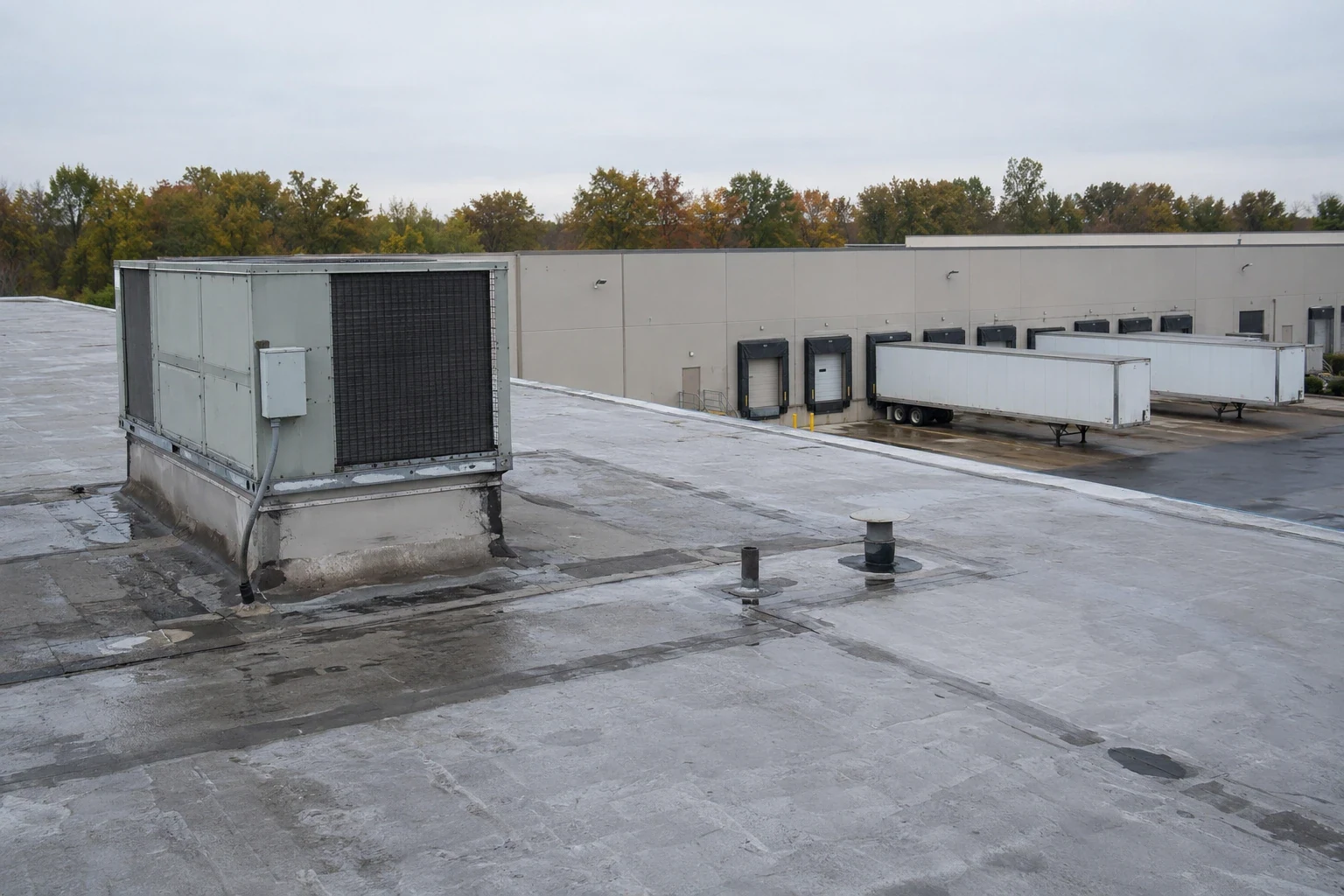
A distribution roof is a long run of membrane with drains set far apart, and ponded water at a drain bowl or a low area is the condition most often missed from the edge. We walk to each drain, clear debris, and photograph the outlet with a tape or level for scale. Where water remains after rain, the depth is measured and logged, because standing water ages a membrane faster and adds weight to a deck designed for a 25-pound-per-square-foot uniform load under Nampa's criteria.
Winter matters here. Because the bulk of the valley's precipitation falls between November and May, scuppers and roof drains are cleared and checked before the cool season. A drain that freezes shut with ponded water behind it puts stress on seams and on the deck. We record each outlet's condition and set a follow-up date for the next visit.
Membrane Choices for Warehouses
A TPO system is one common choice for a new low-slope warehouse roof because it is installed in wide sheets with heat-welded seams, which leaves fewer field laps than narrow rolls. What the existing roof is, however, is a matter of observation, not assumption. We identify the membrane first, then decide whether a repair, a coating, a recover, or a replacement fits.
A recover over sound, dry insulation can keep a building operating with less disruption than a tear-off, since less debris falls and less deck is open at one time. Moisture readings decide whether that option exists. If cores show saturated insulation, the work becomes a tear-off, and the schedule must account for debris handling and a longer dry-in sequence. The file for a distribution center roof states which route was chosen and why, and it keeps the core locations so the next owner can see what the insulation held when the decision was made. If a tenant moves racking after the work, the same plan shows where new foot traffic and point loads now cross the membrane.
Temperature-Controlled Space
Cold storage adds a vapor question. A refrigerated space beneath a roof draws moisture downward through the assembly, and a failed vapor barrier or a wet insulation layer can freeze and damage the space below. On a cold storage roof, we pay close attention to penetrations, because every refrigeration line and vent is a path for vapor. The inspection record shows each one, with the flashing detail and the condition of the surrounding membrane.
Operators who share a campus with a production plant can apply the same discipline to both, and the approach used for manufacturing tenants applies when a building holds both storage and process areas.
Closeout File
When the roof work ends, the operator receives the numbered plan, the photo sequence, the drain record, any test results, and the follow-up date. A landlord who needs to approve work or a client who audits the facility can read the same file. Retail distribution tenants, such as those serving retail and restaurant chains, often ask the operator for proof of building condition, and a dated photo record meets that request.
Questions
How is inventory protected while roof work happens above it?
Protection is agreed with the warehouse manager before work begins. It may include covering racks in the work zone, closing deck openings at day's end, and removing product from the area directly below tear-off.
Which roof section should a 3PL repair first?
The section over the most exposed or most valuable inventory, as shown on the numbered plan. A sound section over low-value storage can wait; a leaking section over a client's stock cannot.
Can the work avoid blocking dock doors?
Yes. We get the dock schedule first, set the lift and staging on a side the trucks do not use, and keep the crew route out of forklift lanes.
What does a landlord need to see before approving roof work on a leased building?
The condition record, the scope of the repair, the repair limit, and the schedule. We assemble these in one set so the approval does not wait on follow-up questions.
How do you handle a roof with long runs between drains?
We walk each run to its outlet, measure ponded depth, and log where water stands. The record shows whether the drain, the slope, or the membrane is the cause.
Does a recover disturb operations less than a tear-off?
Usually, because less debris falls and less deck is open. Moisture cores decide whether a recover is possible, and the file keeps those results.