Roof Systems
TPO Roofing in Nampa, ID
Single-ply TPO roof installation, seam testing and repair in Nampa, ID, with a recorded seam probe, fastener layout and closeout file for the owner.
TPO Roofing
The seam probe log tells an owner more about a TPO roof than the color of the membrane does. On a thermoplastic single-ply roof, the field sheet is a factory product, and the weakest line on the roof is almost always a hot-air weld made on site. For that reason, every TPO scope we write for a building in Nampa, ID starts with the seams: where they run, how wide the weld is, and whether a probe can be pushed under the edge of any of them.
TPO is a sheet of thermoplastic polyolefin, sold in white, tan and gray, that is either mechanically attached, fully adhered or ballasted. The choice among those three methods is a wind and substrate question, and it belongs in the written scope before a roll is opened. A structural deck under a Nampa warehouse and a plywood deck on a small office building will not take the same attachment.
Scope Summary
A new TPO installation on a commercial building is a layered assembly: deck, vapor control where the building needs it, insulation boards, a cover board in many specifications, and the membrane on top. We write each layer into the scope as its own line, because a failure in one layer does not look like a failure in another.
For a replacement, the scope lists what comes off, what stays, and what gets tested before the new sheet goes down. For a recover over an older roof, the scope records the moisture survey that justified keeping the existing layers. Where the old roof is a smooth BUR or a modified bitumen sheet, a recover over the existing roof can save tear-off work, but only where the readings show dry insulation.
Attachment Methods
Mechanically attached TPO uses screws and plates set along the sheet edge under the seam, which keeps the penetrations out of the weather. It is the lighter and often quicker system, and it suits large decks with sound structure. Fully adhered TPO is glued to the cover board over its full area and holds the sheet flat against wind suction, which is why it is common on roofs with tall parapets, where wind curls over the wall and lifts the membrane.
The city's wind figure of 115 mph, with no debris zone mapped, feeds the uplift calculation for the edge and corner zones, and the fastener pattern or adhesive coverage in those zones is written from that figure and the building height, not copied from the field of the roof.
Seam Welding and Probe Checks
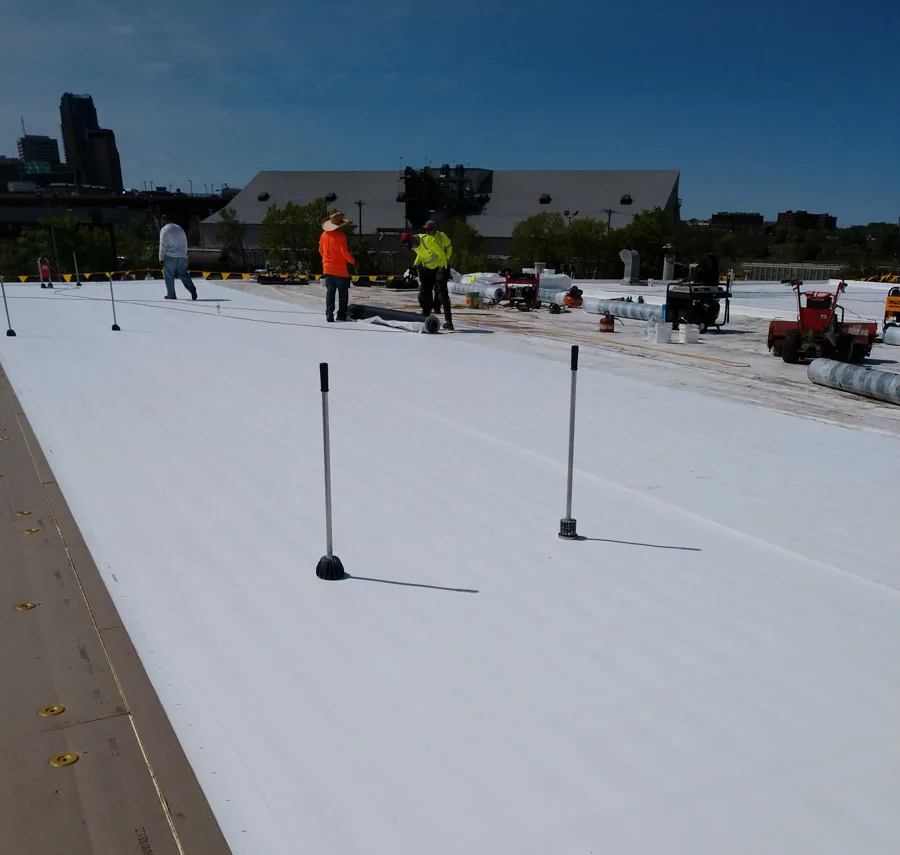
A hot-air welder softens both sheets of TPO at the lap so they fuse into one layer. The weld has to be clean, wide enough for the membrane maker's stated minimum, and free of skipped spots. A technician pulls the welder along a guide line, and when the weld cools, a probe is run along the full seam edge. Any spot where the probe slips under the edge is marked and re-welded.
Probe checks happen on the day of the weld, before the next day's weather can hide a problem. Cold surfaces slow the weld and wet surfaces spoil it, so the weather window shapes the order of work. The probe log lists the roof section, the date, the number of seams checked and the number of repairs made. A TPO roof without that log has seams nobody has tested. Where a lap fails the probe repeatedly, the better comparison may be PVC, whose welds hold up better around grease and chemical exhaust.
Treasure Valley Conditions
The Treasure Valley is semi-arid, with a dry warm season and a cool season that carries most of the moisture. Nearly all of the moisture the valley receives arrives between November and May. On a TPO roof, that means the winter months test drainage, the membrane at the drains, and the lap edges where meltwater sits for days. Add the local ground snow figure of 20 pounds per square foot and a 25 pound roof minimum, and a low area that holds snowmelt becomes a loading question as well.
In the dry season, the white or light sheet reflects solar heat, which lowers the surface temperature of the membrane compared with a dark sheet. That can help rooftop equipment that draws air near the roof, and it is one reason an owner may consider a cool roof installation on a warehouse or distribution building.
Nampa Building Stock
North of I-84 the plan places big industrial tracts and regional commercial sites, and on the east side it pairs commercial activity at the Gateway District with industry. These are the kinds of buildings where a single-ply membrane is a practical choice: many penetrations, and a roof owner who wants a repeatable detail at every curb. The north Nampa industrial tracts and the Gateway District are places where a TPO scope can be written around equipment layout and drainage.
State Highway 16 carries a code rule that keeps rooftop mechanical units off any structure within 500 feet of the road. A TPO design in that corridor has to plan for ground-level or screened equipment, and the roof drawing should show where the units were moved, not leave an empty patch of membrane that later gets a curb added without a permit.
Flashing and Penetration Details
Seams in the field are only part of the TPO story. The details at walls, curbs, drains and pipes use either preformed accessories or hand-cut flashing welded to the sheet. We photograph each detail before the next layer covers it, because a flashing that is hidden by counterflashing cannot be checked again without opening it.
Where a roof has many penetrations, we count them and record each one by location on the plan. A skylight or penetration flashing is the most common place for an early failure on any single-ply roof, so the plan gives it its own line and photo set.
Closeout File
At the end of a TPO project the owner receives the closeout file: the membrane and insulation product data as installed, the fastener or adhesive layout, the probe log, the photo sequence, any scope revision made after tear-off, and the follow-up date for the first walk-through. Compared with a rubber sheet, as in EPDM roofing, the welded laps give TPO a seam that fuses instead of one that is taped. Owners with several buildings can fold these files into a roof condition report program.
Questions
Which attachment method suits a wide warehouse deck?
Mechanical attachment is the usual starting point for a wide, sound deck, since it moves quickly and keeps the number of glued areas low. The edge and corner zones may still call for tighter fastener spacing or adhesive, and the wind figure and building height set that. The layout drawing records the answer for each zone.
How is a TPO seam tested after welding?
A probe is dragged along every seam edge once the weld cools. Any spot where the tip enters is marked, re-welded and checked again. The log records the roof section, the date, and the count of repairs.
Can TPO go over an old BUR roof?
Sometimes. A moisture survey comes first, and the existing roof has to be dry, firmly attached and flat enough to take a cover board. Where insulation is wet, the wet portion comes out and the rest is re-checked before any membrane is laid.
Does snow load change the TPO design?
Snow load belongs to the structure, not to the membrane, but it affects drainage and insulation choices. Nampa's design criteria list a 20 pound ground snow load, so we look at low areas where snowmelt could pond and record any tapered insulation that corrects them.
What is in the file when the job ends?
The file holds product data, the attachment layout, the probe log, photographs of every flashing detail, and any scope revision. It also lists the follow-up date for the first walk-through, so the first winter is not left unreviewed.