
Commercial Roofing Services
Skylight and Penetration Flashing in Nampa, ID
Skylight, curb, and penetration flashing repair for commercial roofs in Nampa, ID, with leak tracing, staged photographs, and detail-by-detail records.
Skylight and Penetration Flashing
A leak under a skylight rarely starts at the glass. The record begins with a count: how many openings pierce the roof, what each one is, and which of them has a stain beneath it. Skylights, vent stacks, conduit risers, pipe boots, exhaust fans, and gas lines each pass through the membrane, and each passage is a flashing that has to hold. Walking the roof with a plan and marking every penetration shows where the leak history clusters, and clusters point to the detail that failed.
In Nampa, ID, flashing at openings takes a particular beating. Summer sun degrades sealants and rubber boots, winter freeze-thaw moves curbs and pipes against their flashings, and snow, which the city's design criteria rate at a 20 pound per square foot ground load, drifts against anything that rises above the roof surface. Water follows the path of least resistance, and the penetration is usually the lowest-resistance point on the roof.

Skylights and Curbs
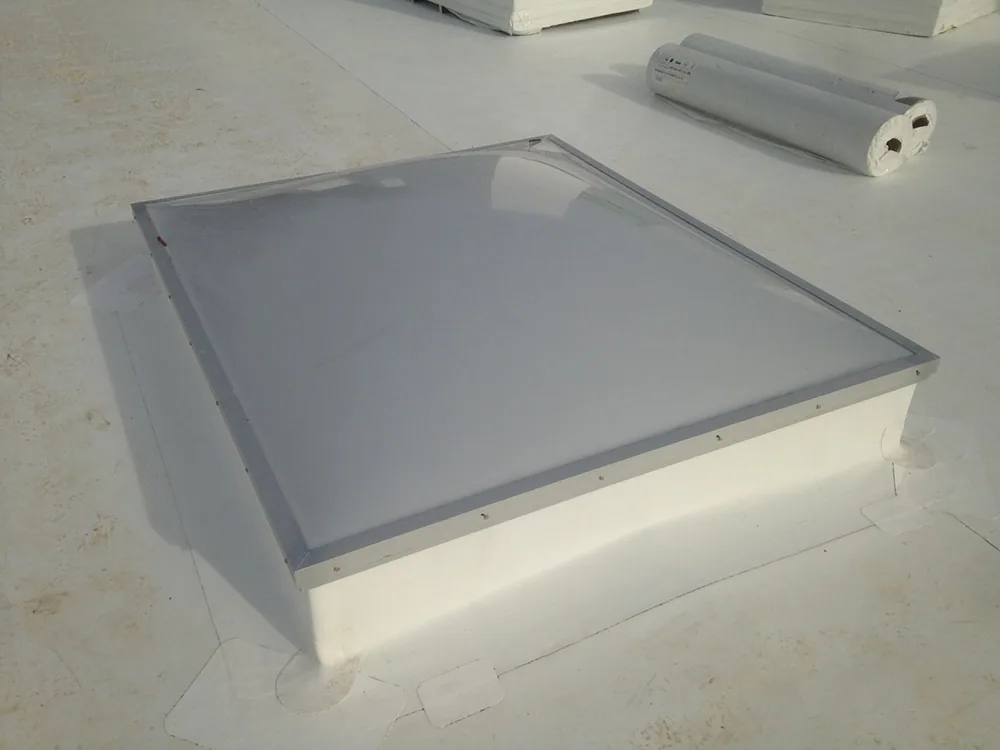
A skylight sits on a curb, a short raised frame that lifts the glazing above the roof plane. Water leaks at a skylight come from one of four places: the base flashing around the curb, the joint between the curb and the frame, the glazing seal, or condensation inside the unit that looks like a leak. Each is checked in order, because tracing a leak backward from the stain through each possibility is faster than replacing the unit.
If the curb is sound and the flashing has failed, the base flashing is replaced with the same membrane as the roof, wrapped up the curb and terminated beneath the frame's counterflashing. If the curb itself has rotted or the unit is aging, replacement of the whole skylight with a new curb and flashing is quoted as a separate line. Where a skylight is no longer needed, removing it and decking over the opening permanently eliminates a leak point.
Pipes, Stacks, and Conduit
Small round penetrations are flashed with boots, pitch pans, or prefabricated membrane flashings. Rubber boots crack in sunlight, and a split boot funnels water straight down the pipe. A pitch pan filled with pourable sealer shrinks and cracks over time, leaving a gap around the pipe. Either one can cause a leak that shows up in spring after the first heavy melt.
The fix depends on the membrane. On a TPO roof, a prefabricated boot is welded to the field membrane and sealed at the top with a clamp. On an EPDM roof, a molded boot or a field-fabricated flashing with cured splice tape is used. Modified bitumen and built-up roofs may take a flashing of the same material with a metal collar. Every repaired pipe is photographed from above and from the side, so the detail can be reviewed without climbing.
Equipment Curbs and Exhaust
Large penetrations such as exhaust fans, make-up air units, and mechanical curbs carry the most flashing and the most movement. A unit that vibrates loosens its seal, and a curb that is not fastened to the deck can shift under load. When service crews move across a curb, they may step on its flashing and open a seam.
The roof around such equipment is inspected for sealant condition, fastener backout, and abraded membrane, and rebuilt where needed. Details for these larger openings overlap with the equipment curb and support work, since a leaking curb and a poorly supported unit are often the same problem. Within 500 feet of Highway 16 the city plan bars roof-mounted mechanical units, so on a roof there the vents, conduit, and skylights are the main openings to keep sealed.
Leak Tracing
Tracing a leak to a penetration needs a method. We start with the interior stain, mark its position on the roof plan, and check every opening within a radius of that point, including ones that are not directly above it, since water travels along decks and insulation. A controlled water test, run in stages from the low side of the area upward, confirms the entry point before any repair is made. Each stage is timed and photographed.
Results are recorded with the test conditions. A flashing that leaks only under wind-driven rain is different from one that leaks under a hose, and the record says which test reproduced the leak. When the stain stays after repair, the file shows whether the moisture is residual or new. The same sequence drives any commercial roof leak repair that starts at an opening.
Where Penetrations Cluster
In the Gateway District, commercial buildings and light industrial uses share the area, so the penetration mix changes from one building to the next. Along Ustick Road and Highway 20/26, where the plan describes industrial and regional commercial uses replacing agricultural land, the same is true. The scope in each case lists every opening, whether it is repaired, replaced, or left alone, and why.
Materials at the Opening
Flashing materials must match the membrane around them, or the joint becomes the weakest point on the roof. Thermoplastic membranes accept welded flashings, and a weld that cools without contamination is stronger than the sheet itself. Rubber membranes take adhesive and splice tape, which need clean, dry, primed surfaces. Mineral-surfaced bitumen flashings are torched or mopped in layers and finished with a surfacing that resists sun.
Sealants are a temporary measure at most openings. A bead of sealant can close a hairline gap for a season, but it ages quickly in Nampa's summer sun, and a flashing that relies on sealant alone needs a recheck date. When sealant is used, it is labeled as such in the file, with the product type and the date it should be inspected again.
Detail Closeout
The closeout file shows each penetration with a before, during, and after photograph, the material used, and the test result. Flashing failure history is logged per opening. Details that were found sound are recorded as sound so they do not reappear as suspects at the next leak. The file also lists any penetration that should be reviewed at the next maintenance visit, with a reason. Over the life of the roof, this inventory becomes the reference that tells a crew where the leaks have been and where they are likely to return.
Questions
Why does a skylight leak only after snowmelt?
Melt sends water against the curb for hours, and a small gap in the flashing that stays dry in rain lets it through. Drifted snow can also bank against the curb and hold water at the base. The flashing is rebuilt and the curb height checked.
Can a pipe boot be repaired instead of replaced?
A cracked rubber boot is replaced, since sealant over a split boot gives only a short fix. A boot with a sound collar and a failed seal at the top can sometimes be resealed. The decision follows a close look at the material.
How many penetrations are too many on one roof?
There is no set number, but each opening is a possible leak. Where equipment has been removed or conduit abandoned, we recommend capping and decking over the openings that serve nothing.
Does flashing work need the whole roof open?
No. Flashing is replaced opening by opening, with the area around each opening protected while it is open. A repair that covers only the failed detail leaves the rest of the membrane undisturbed.
What if the leak returns after repair?
The file shows what was done and what was tested, so the next step narrows quickly. A return leak often means a second entry point nearby, and the water test identifies it.