Commercial Roofing Services
Commercial Roof Repair in Nampa, ID
Planned repair of commercial membrane, flashing, seams, and roof details in Nampa, ID, with a photo-backed defect inventory and stated repair limits.
Commercial Roof Repair
A marked photograph settles more repair decisions than a quote does. The crew walks the roof section first. Each defect gets a number on a plan, and a photograph is taken from an angle that can be repeated later, all before anyone opens a seam or a flashing. That inventory shows the owner what is failing, what is merely worn, and what is still sound, and it gives the repair a boundary: the limit past which the work stops being a repair and becomes a conversation about the roof.
A planned repair on a commercial roof in Nampa, ID can mean a built-up or modified bitumen section, or a single-ply membrane with seam or flashing trouble. The repair method changes with the membrane, so the inventory begins with identifying what the roof actually is, then moves to the defects.
Defect Inventory
The inventory sorts findings into four groups: membrane defects such as splits, blisters, and punctures; seam defects where laps have opened or lost adhesion; flashing defects at walls, curbs, and penetrations; and drainage defects such as clogged drains and ponding. Each item receives a location, a size, a photograph, and a proposed method. Items that need testing before a method is chosen are listed separately as open questions, so the owner can see the difference between a confirmed repair and a conditional one.
The same inventory is useful beyond the repair. It becomes the first page of a condition report for the building, and a later inspection can compare against it. Owners who manage several properties often keep these inventories together so repair budgets can be ranked by defect type instead of by whoever called last.
Access is part of the inventory too. We note how the crew reaches the roof, where equipment can be staged, which hatches and ladders are available, and what fall protection the roof edge requires. A roof reachable only through a tenant suite needs a scheduled entry window, and that window goes in the file so the repair does not stall at the door.
Membrane and Seam Methods
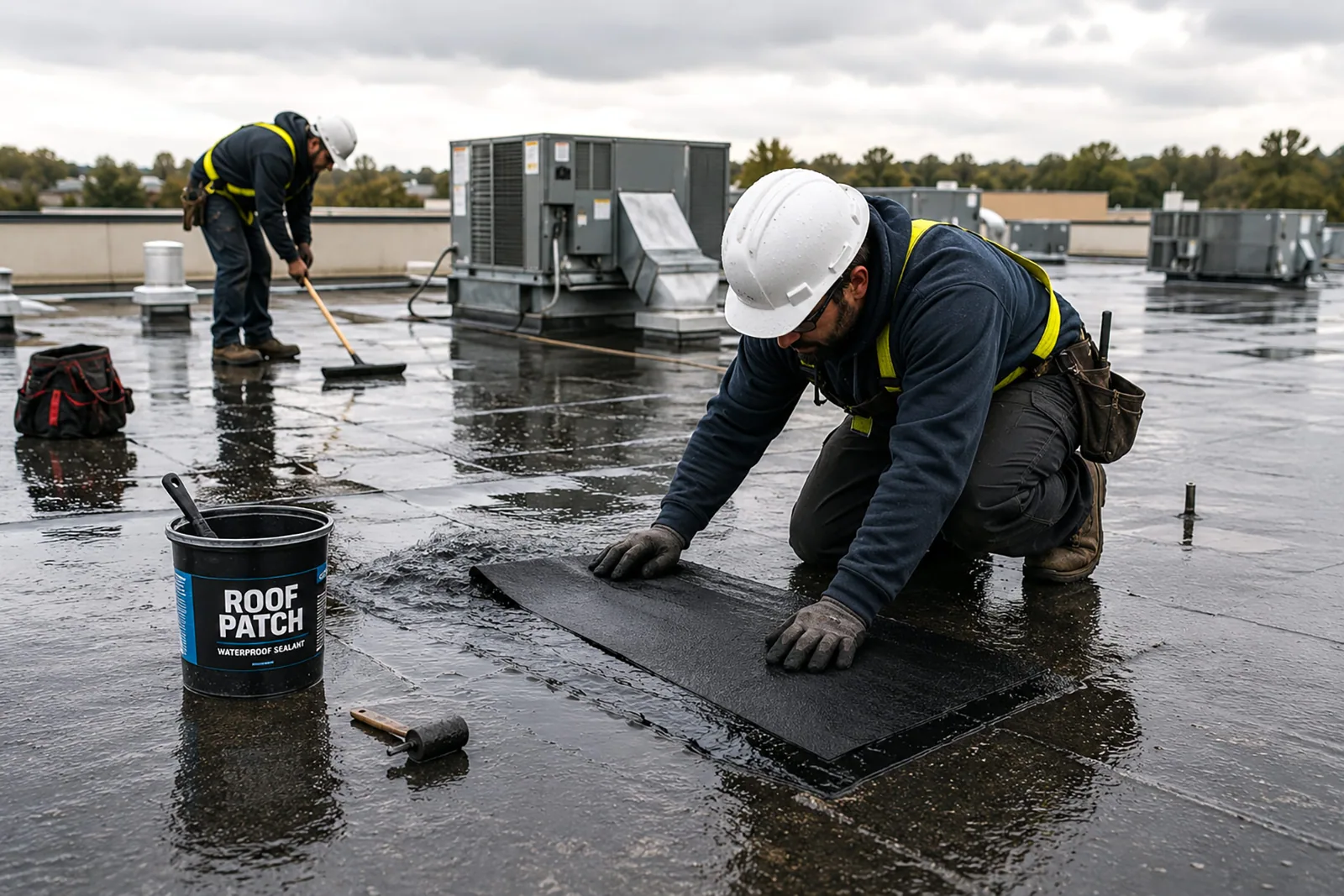
Repair method follows membrane type. Thermoplastic membranes such as TPO and PVC are repaired with heat-welded patches after the surface is cleaned, since a clean weld holds where adhesive over dirt will not. EPDM repairs use splice primer and tape or a cured patch over a cleaned and dried surface. Modified bitumen and built-up roofs take hot or cold-applied patches and reinforced mastic at splits and blisters, and a granule-surfaced cap sheet needs its surface restored so the patch does not become a point of UV wear.
When the cause is a failed lap, seam repair follows a probe test along the full length of the seam, not only the open section, because an opened lap usually has weak neighbors. A membrane puncture is also checked for wet insulation beneath it before it is patched, since a patch over a wet board only seals the water in.
Photo Sequence
Every repair is photographed in three frames from the same position: the defect as found, the prepared surface, and the finished detail. A fourth wide frame places the repair on the roof section so a reader can find it without a guide. We number files to match the inventory, which means a property manager can open the folder a year later and match each image to a line on the plan.
The sequence also protects the work. If a seam opens again within the first season, the prepared-surface photograph shows whether the substrate was clean and dry when the weld or tape went on, and the finished-detail photograph shows the lap width. That evidence tells the owner whether the cause was workmanship, material, or a movement problem in the building, and it points the follow-up toward the right fix instead of a second guess.
Flashing and Detail Work
Many active leaks on commercial roofs start at the details, not in the field of the membrane. Base flashing at a parapet pulls loose when the wall moves, counterflashing opens at a mortar joint, and pipe boots crack in sun. Repair means removing the failed termination, preparing the substrate, installing new flashing with a reinforced corner, and finishing with a termination bar or sealant that matches the membrane. Flashing failure repair is photographed in stages, since the finished flashing hides the substrate work that makes it last.
Nampa's north quadrant plan names the Karcher interchange as an I-84 access point and describes industrial and regional commercial uses along Highway 20/26 and Ustick that are replacing agricultural land. Wherever a roof carries rooftop equipment, every curb adds four corners that need sound flashing, and we check those corners first when leak complaints cluster near the same unit.
Repair Limits
A repair limit is the stated point where continuing to patch no longer makes sense. We set it in writing from the inventory: for example, a section where wet insulation exceeds a threshold shown by moisture mapping, or one with seam failure along most of its laps. Beyond that line, the better question is a recover or a full replacement, and the owner receives the numbers to compare.
The limit also protects the owner from a repeating cycle. A roof patched five times in a year has no record explaining why, and the next patch is guessed. A repair file that lists dates, locations, and photographs shows whether failures cluster at a detail, a drain, or a seam type, and the cluster usually points to the real cause.
Freeze-Thaw and Weather Windows
Climate affects repair timing more than most scopes admit. Most of the valley's yearly precipitation falls from November through May, and the city's design criteria set the winter design temperature at 10 degrees Fahrenheit. Cold, damp surfaces reduce adhesion, so permanent repairs are scheduled for dry windows, and temporary repairs in winter are labeled as temporary in the file with a return date.
The maintenance visits before and after winter catch loosening details before snowmelt finds them. For buildings in East Nampa, where commercial and industrial uses sit side by side, one spring walk of the roof usually shows which details need work before the dry season begins.
Questions
How much of a roof can be repaired before replacement makes sense?
The inventory answers it. When wet insulation or failed seams cover a large part of a section, the repair limit is reached and replacement or recover should be priced against continued patching. A small isolated defect stays a repair.
Do you repair every membrane type?
We repair TPO, PVC, EPDM, modified bitumen, built-up, and metal roofs, each with its own materials. The first step is identifying the membrane, because a patch that suits one system can fail on another.
Why test a seam beyond the visible opening?
Neighboring lap sections often share the same weakness, so a probe along the whole seam finds the next failure before it leaks. The result goes in the file with photographs of the tested length.
Is a winter repair permanent?
Usually not. Cold, wet surfaces limit adhesion, so winter work is marked temporary and a return date is set for the dry season. The owner sees both the interim repair and the planned permanent one.
What does the repair file contain?
Numbered defects on a roof plan, before and after photographs, the method used for each, any test results, and the follow-up date. It is written to be read by the next owner or an insurer without a walkthrough.