Commercial Roofing Services
Roof Recover and Overlay in Nampa, ID
Recover a commercial roof in Nampa without a full tear-off when moisture findings, code limits, and the deck allow it, with a written eligibility record.
Roof Recover and Overlay
Moisture readings settle a recover before price does. A recover leaves the existing membrane and insulation in place, adds a cover board or new insulation, and installs a new membrane on top, so every wet square foot left under the new roof becomes a problem that cannot be reached later. The decision therefore starts with a moisture map, a set of core cuts, and a count of the layers already on the deck, all recorded on a roof plan before anyone prices a membrane.
For commercial owners in Nampa, ID, the appeal is plain: no tear-off debris, less exposure to weather, and less disruption inside the building. The limit is equally plain. Dry insulation, a sound deck, and a layer count that the adopted codes allow are all required, and a roof that fails any one of them goes to full replacement instead.
Eligibility Findings
We record four conditions for each roof section before a recover is offered. First, the existing insulation reads dry in a grid of moisture readings, confirmed by cores at the points that look most suspect. Second, the deck holds fasteners and shows no section loss. Third, the number of membrane layers on the roof does not already reach the limit set by the building and existing-building codes. Fourth, the slope and drains can carry water off the finished roof, because a recover raises the surface and can change how water reaches a drain.
The recover limits and the wet-insulation exclusions live in the building and existing-building codes, and Nampa has adopted the 2018 editions of both. We state the governing edition in the scope and ask the building department to confirm anything unusual, such as a roof with a prior recover already installed.
Added Weight and Snow Load
A recover adds dead load, and the amount depends on the system. A single-ply membrane over a cover board adds little. Ballast, thicker insulation, or a second layer of heavy mineral-surfaced material adds more. Nampa's design criteria set the minimum uniform roof load at 25 psf and the ground snow load at 20 psf, so the structural question is whether the framing has capacity left after the recover is installed. Where the original drawings are missing, we recommend a structural review before the scope is fixed rather than a guess about the framing.
Snow and drainage interact here. Most of the valley's precipitation arrives from November through May, so a recovered roof meets a full wet season before it meets a dry one. A recover that leaves a low spot beside a drain will hold meltwater through a freeze-thaw cycle, so the plan marks every drain and the finished slope toward it. A tapered cover board is often the cheapest way to fix that, and the cover board and insulation choice belongs in the same scope.
Layer Sequence
The sequence runs from the deck up and is written into the scope so each layer can be photographed. Loose gravel, blisters, and failed flashings come off first. Wet or crushed insulation spots found during the survey are cut out and filled with dry board of matching thickness. A cover board or separation layer goes down next, then the new membrane, adhered or mechanically attached according to the wind criteria, which in Nampa include a 115 mph ultimate wind speed.
Over a metal deck, fastener length and spacing change because the new layer sits higher than the original one. Over a built-up roof, the new assembly may need a vapor control layer so trapped moisture can escape. These details are why a recover on a flex industrial building in the east quadrant is rarely identical to a recover on a retail strip, even when both are single-ply. A TPO membrane is the common choice over a sound substrate, though PVC and other single-ply systems are also installed.
Edges, Curbs, and Penetrations
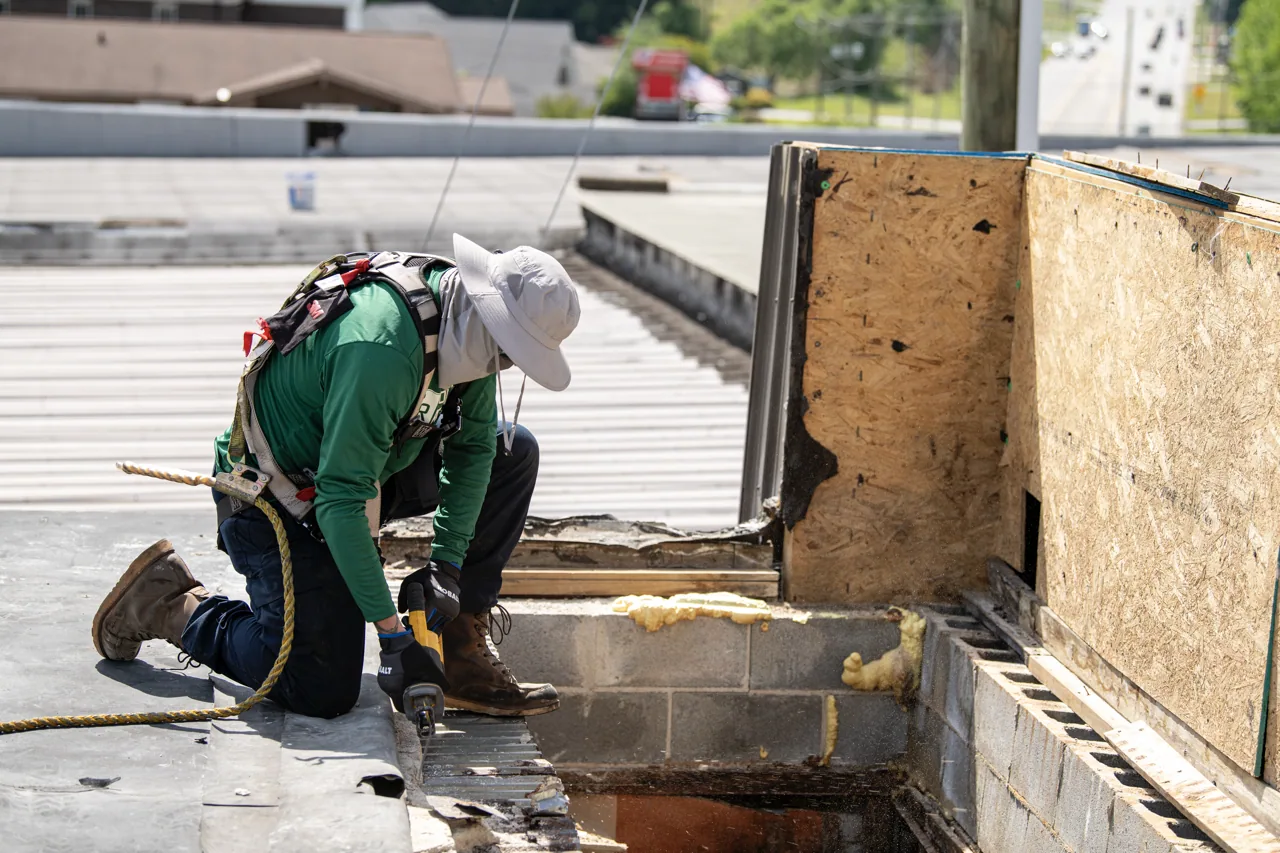
A recover raises every flashing, so details are rebuilt rather than patched. Edge metal is extended or replaced to cover the thicker assembly, curbs receive new base flashing at the new height, and pipe penetrations are boot-flashed again. Rooftop units sometimes need to be lifted for this work, and we schedule that with the mechanical trade so the units are not out of service longer than the day they are disconnected.
Near the Garrity corridor, the east quadrant mixes the Nampa Gateway District's commercial space with light and heavy industrial areas, and a roof on an industrial building can carry exhaust, make-up air, and conduit runs. Each penetration is photographed before and after. If a penetration is abandoned, it is removed and the deck patched instead of covered, because a capped pipe under a new membrane is the next leak. The flashing at skylights and penetrations receives the same treatment.
Open Questions
Some conditions stay concealed even after a survey. Moisture can sit in a joint between insulation boards that no core touched, and a deck can hide corrosion beneath dry foam. The scope says which concealed conditions would stop the recover, and the owner approves the fallback in advance: either cut out and patch the discovered area or move that section to tear-off. Both options carry a quantity, a photograph, and a follow-up date.
For a building in historic downtown Nampa, the first task is learning how many layers already sit on the deck, since that count and the state of the old surface control adhesion. The record we produce is built to be read by the next owner, the next lender, and the next roofer, so the layer history stays attached to the building.
After the recover, the first winter is the test. We schedule a follow-up walk once snow has melted, photograph the drains and low areas from the same positions as the closeout set, and compare them. Ponding that was absent at completion and present in March points to deck movement or a drain problem, and the comparison photographs make that visible while the repair is still small.
Questions
Which roofs cannot be recovered?
Roofs with wet insulation, a deck that has lost section, or a layer count already at the code limit. A moisture survey and a handful of core cuts show which side a roof falls on. Roofs that fail go to tear-off.
Will a recover raise the roof enough to affect drainage?
It can. Thicker assemblies raise the surface and change how water reaches drains and scuppers. We check the finished slope, and a tapered cover board corrects a low spot before it holds meltwater through a freeze-thaw cycle.
How does the added weight compare with Nampa's snow load?
Two city design figures frame the question, a 20 psf ground snow load and a 25 psf minimum uniform roof load. The recover adds dead load that must fit inside the framing capacity, so structural drawings or a review come first when the weight is more than a thin membrane.
What does the recover do to the manufacturer warranty?
That depends on the new system. The specified membrane carries its own paperwork, issued by its manufacturer on completed work, and the closeout file lists the product data and inspection photographs the manufacturer asks for. Existing warranties on the older layers are reviewed before work starts.
Can a leaking roof still be recovered?
Sometimes, if the leak is local. A traced leak repaired first, followed by a moisture survey, shows whether the wet area is contained. If the wet area is broad, a recover only hides the problem.