Roof Damage Repair
Ponding Water Roof Repair in Nampa, ID
Ponding water roof repair for commercial buildings in Nampa, ID: depth measured, drains cleared, low areas traced, and drainage corrected or tapered.
Ponding Water Roof Repair
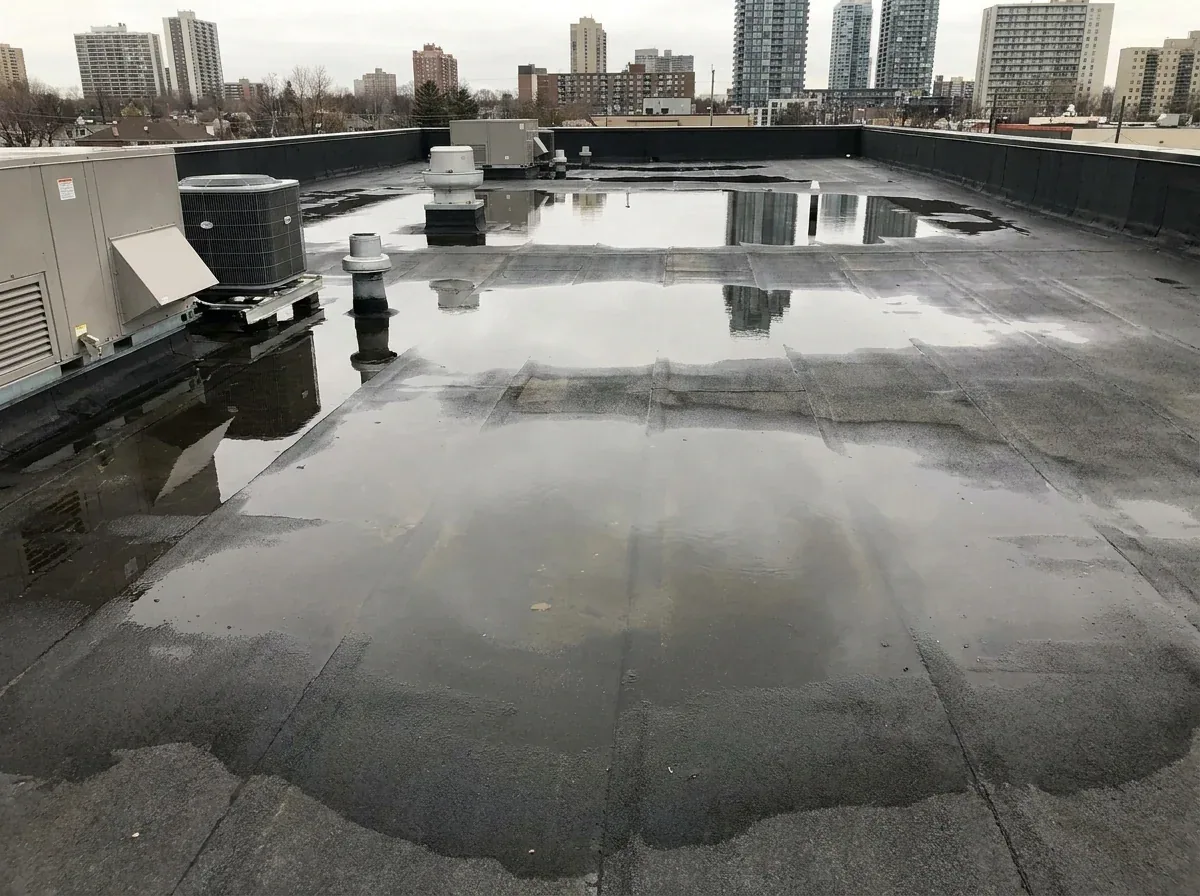
Measure the water before deciding what it means. A puddle that is gone a day after rain is a drainage note. A puddle that stays for a week, grows, or freezes and thaws in winter is a defect, and it needs a depth, a location, and a cause before anyone picks a repair. On a commercial roof in Nampa, ID, the first job is a tape measure, a level, and a camera: record the depth at the center of the pond, the distance to the nearest drain, the date of the last rain, and the time elapsed since.
That record separates a roof that drains slowly from a roof that holds water by design or by deflection. The repair that follows depends on which one it is.
Why Water Stays
Water stays for a handful of reasons, and the reasons rarely occur alone. A drain may be clogged with debris, or set higher than the membrane around it. The deck may have deflected under equipment weight or under a past snow load and left a low area. Insulation may have compressed where traffic is heavy. The slope may never have been enough to move water to the drains. Or a repair may have raised the surface near a drain and dammed it.
We trace each pond to a cause by walking the water path, and a membrane puncture or open seam found in the pond area is recorded with the same number, as in a puncture repair or a seam repair, since standing water finds the smallest opening. We check the drain bowl, the strainer, the sump, and the pipe below, then the surface around them, then the plan slope. If the cause is a clog, the fix is cleaning. If the cause is a low area, the fix is tapered insulation or an added drain. Local design rules call for a uniform roof load of 25 psf at minimum against a 20 psf ground snow figure, so a deck that has deflected under loads in that range is a structural question as well as a roofing one.
Winter and Freeze-Thaw
The wet months run November through May and carry most of the valley's yearly moisture, while the local design criteria set a 24-inch frost depth and a 10 degree Fahrenheit winter design temperature. On a roof that holds water, that calendar means ponds that freeze, thaw, and freeze again. Ice pushes against seams and flashing. The water adds weight to a deck, and when the ice melts it finds every small defect in the membrane.
Winter inversions and snow cover can make valley locations colder than Boise airport readings, so a Nampa roof may see more freeze cycles than the regional forecast suggests. We document ponds in the fall, after the first freeze, and after the first thaw, so the record shows whether a pond grew, shrank, or moved.
Drains, Scuppers, and Outlets
Most ponds trace back to an outlet. We clear roof drains and scuppers, photograph the bowl before and after, and check the flashing around it. A drain whose ring sits above the surrounding membrane is lifting water instead of lowering it, and a cracked or clamped membrane at the drain ring is a leak path. Strainers are replaced where missing. Where a scupper sits above the membrane line, we note the offset and propose a lowered scupper or a sump.
When the roof has too few drains for its area, the repair may add one, and an overflow scupper is considered where the code or the owner requires secondary drainage. Each new outlet is flashed and tested, and the plan records its location.
Correcting the Low Area
Where a pond comes from slope, the fix is to build slope. Tapered insulation, installed under a new membrane or over existing insulation after the roof is stripped, moves water toward drains. A cricket behind a curb or around a unit sends water around the obstacle. Cover board over crushed insulation restores a flat surface, and a cover board specified for the traffic it will see keeps the repair from compressing again. Where the pond is small and the membrane sound, a localized fill under a patch may suffice, but the file states why the owner chose it over a larger correction.
The choice also depends on the membrane. A rubber membrane in a pond may stay serviceable for a time, while some membranes carry limits on ponding in their warranties. If the owner holds a manufacturer's warranty, the ponding condition must be addressed before it creates a dispute. Insulation under a pond is checked for moisture with an infrared survey, because wet insulation does not hold a repair.
Roofs Along the Corridors
The city plan describes industrial tracts near I-84 in the north, a mix of commercial and industrial uses around Gateway in the east, and a railroad that separates the east quadrant from the south. Low-slope buildings along those routes, from the rail corridor to the 12th Avenue corridor, all share the same weather and the same drainage questions. The plan does not describe their roofs, so each report starts from the roof actually found.
Follow-Up Record
After repair, the same measurements are taken at the same locations. The record compares before and after depths for each numbered pond, shows the new drain or taper, and sets a follow-up date for the next heavy rain or thaw. If the pond has returned, the file shows whether the cause was the one first named or a second one hidden behind it, which tells the owner whether the correction failed or only half of the cause was found. Equipment placement affects ponds too. A curb or a rack of conduit can dam a path that once drained, and a technician who sets a ladder in the same low spot every month compresses the surface. We note the location of each obstruction in the water path and propose a cricket, a raised support, or a relocated line. Where snow slides from a higher roof onto a lower one, the drift area melts slowly, and the drain that serves it is checked first. For owners who want ongoing checks, commercial roof repair visits can include a ponding walk, and the findings carry forward in the condition file.
Questions
How long may water stand before it is a defect?
Water that remains well beyond a day or two after rain points to a drainage problem. We record the depth and the time since rain and trace the water path before choosing a fix.
Is ponding always a leak?
It is not a leak by itself. It ages the membrane faster, adds weight, and exposes any small defect. The repair depends on whether the pond has found one.
Can tapered insulation correct a pond without replacing the roof?
Sometimes. It is placed under a new membrane, so the existing membrane usually comes off or is covered, and the insulation condition decides.
What if the deck has sagged?
A sagging deck is a structural question. We report it with measurements and photographs, and an engineer decides the correction.
Do ponds affect a manufacturer's warranty?
Some warranties limit coverage where water stands. The warranty paperwork should be checked, and the pond record helps show what was found and when.
When are drains checked?
Before the cool wet season, after the first hard freeze, and after the first thaw. Each visit is photographed so changes are visible.