Service Areas
Commercial Roofing in Wilder, ID
Commercial roof repair, recover, coating and replacement for Wilder, ID, about 18 miles northwest of Nampa, with a dated photo record of each roof section.
Wilder
Wilder's own comprehensive plan sorts its land into commercial, industrial, and mixed-use designations, and that three-part split is the first thing a roofer should read before driving out. Each designation tends to bring a different kind of roof, and each needs a different first question: a commercial building raises flashing and rooftop equipment, an industrial building raises drainage and seam length, and a mixed-use building raises tenant access. Our visits to Wilder, ID, about 18 miles northwest of Nampa, start from that sorting.
We do not arrive with an assumption about what is on the roof. The first walk produces the inspection record: the roof sections, the visible condition of each, the date, and a photograph taken from an angle that can be repeated at the next visit. Everything that follows, from a small repair to a full replacement, is measured against that record.
Land Designations and Roof Types
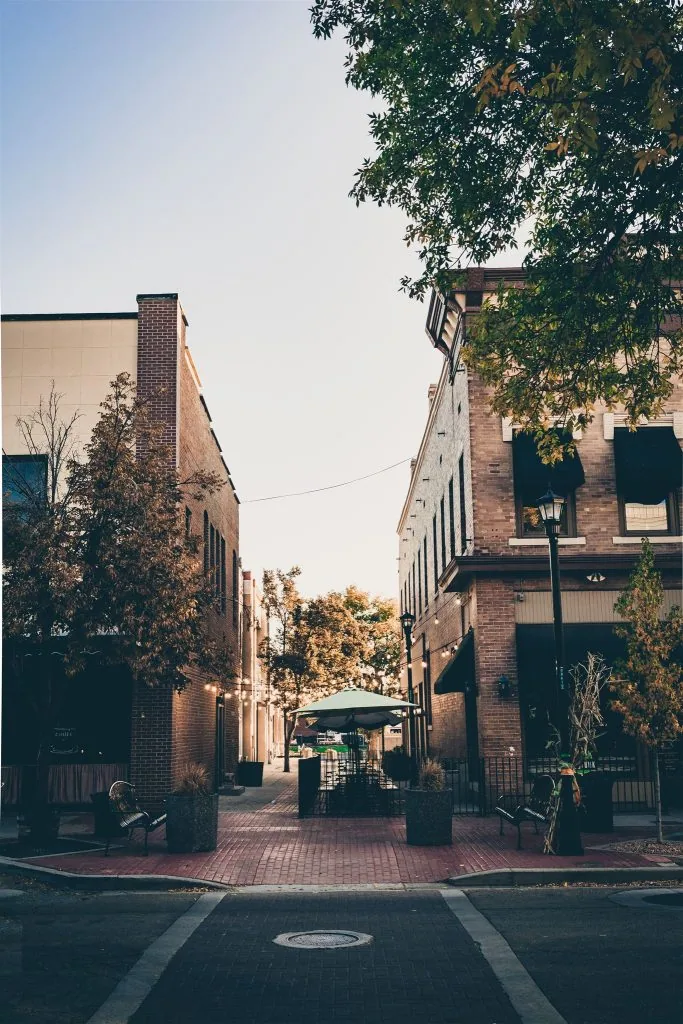
A commercial designation in a small town plan can point to storefront-scale buildings, where the roof is a single low-slope surface with a parapet, a few rooftop units, and edge metal that sheds water into a scupper or a gutter. The failure points on those roofs are small and local: a cracked sealant joint at a parapet, a loose termination bar, a unit curb that has settled. They are found by walking the perimeter and every curb in order.
An industrial designation points the other way. Longer seams, larger roof sections, and interior drains mean that a single blocked drain can hold water over a wide area, and a pool of water sitting on a lap seam is the first thing we photograph and measure. Mixed-use land adds the question of who has the roof key, since the owner, the tenants, and the equipment vendors may all need access. We write the access conditions into the file before any scope is priced.
Agriculture and Food Processing
The Boise-Nampa labor market that Wilder belongs to has an agricultural and food-processing economy. Roofs over that kind of work carry loads that office roofs do not. Process buildings produce exhaust and moist air that leave stains and corrosion around vents, and storage and packing buildings often sit under long, plain roof surfaces with few drains.
For an owner in that line of work, the useful inspection record separates what the building does from what the roof does. Corrosion at an exhaust stack is a flashing condition. A wet patch of insulation near a washdown line is a moisture boundary that a scan can map. A seam opened by repeated expansion is a membrane condition. When we write those apart, the owner can see which items are maintenance and which are structural to the roofing system, and can plan the budget in that order. The same inspection format applies in Caldwell, which sits in the same labor market.
Winter Load and Dry-Season Work
For winter planning around Wilder we start from Nampa's city design criteria, the nearest adopted local reference. The ground snow figure in that document is 20 psf, the floor for uniform roof design load is 25 psf, and the ultimate wind speed is 115 mph. Those numbers belong to Nampa, they are planning references and not a calculation for any building in Wilder, and the structural drawings of the building decide what its deck can carry.
More than 75 percent of the valley's yearly precipitation falls from November through May. In practical terms, winter is the season for drainage checks and for photographing seams after freeze-thaw cycles, and the dry warm season is when membrane work, coating, and tear-off are scheduled. A section that held water in March goes back on the list for the first dry weeks, and a leak that cannot wait for those weeks receives a temporary repair at once, with the permanent scope written after.
First Walk Sequence
The walk follows a fixed order so that a later visit can be compared line by line. We begin at drains, scuppers, and gutters, recording whether each is clear and whether the line below takes water. Next is the field of the membrane, photographed in a grid, then the edges and flashing, then every penetration and curb. Soft spots are marked and photographed from two sides.
Where the surface leaves doubt about trapped water, an infrared moisture survey maps the suspect area, and a small core test confirms it. The result is drawn on the roof plan as a boundary line, and every repair quantity is priced from that line. A full commercial roof inspection ends with a written scope in two columns: work we confirmed, and conditions nobody can see until the membrane is cut open.
Repair, Coating, Recover, Replace
An owner in Wilder has four ordinary paths. A repair fixes the one seam, flashing, or puncture that failed and puts a recheck date on the calendar. A coating system extends a membrane that is still sound but weathered, and it is only an option when the insulation beneath is dry. A recover overlay lays a second membrane over an existing roof that is still sound and dry. A replacement removes the old roof to the deck and is the choice when moisture has spread or the deck is damaged.
Cost and schedule follow a short list of drivers: how far wet insulation extends, how many curbs and penetrations the roof has, what access a lift or crane needs from a site outside the Nampa core, what the operations below cannot tolerate, and how many dry weeks remain before the wet season. Each of those goes into the scope revision so a change in price can be traced to its cause.
Closeout File
The finished file holds the before and after photographs sorted by roof section, the results of any moisture or drain-flow tests, the repair limits as built, and the date of the next walk. Anything we could not prove on site, for example wet insulation hiding under a surface that looked dry, is written down with the test that would resolve it. Owners who manage buildings in Wilder and in Middleton or along Highway 20/26 receive the same format, which keeps a small portfolio comparable from one roof to the next.
Questions
What should be on hand for the first roof walk in Wilder?
Send the roof plan if one exists, the warranty paperwork, and the dates of any past leaks. Access matters as much as paperwork: where the hatch or ladder is, who holds the key, and which hours are quiet inside the building.
Is a coating a realistic option for an older low-slope roof?
Only if the insulation is dry and the membrane is sound enough to bond a coating. Infrared and core tests settle that. If readings show wet insulation, the coating is deferred and the scope moves to repair or replacement.
Which roof sections get walked first at a processing or packing building?
Drain sections come first, because ponded water exposes a failure sooner than anything else. Sections around exhaust stacks and vents come next, because moist air wears flashing and metal faster there.
Can winter findings wait for spring?
Most can, if the roof is not letting water in. They go into the record with photographs and a priority, and the permanent repair is scheduled for a dry-season window. Active leaks get a temporary repair right away.
Do you take emergency calls this far from Nampa?
Yes. Water coming through a ceiling in Wilder is handled the same day it is reported, at any hour, with a temporary seal first and the full scope written afterward.