Commercial Roofing Services
Roof Coating Restoration in Nampa, ID
Coating restoration for sound commercial roofs in Nampa, ID, with moisture mapping, adhesion testing, and a written record of what a coating can cover.
Roof Coating Restoration
The adhesion test comes before the coating bid. A small patch of primer and coating is applied to a cleaned area of the existing roof, left to cure, and then pulled to see whether it holds. If it lifts, the roof needs a different surface preparation or a different system. If it holds, the restoration can proceed on a measured basis. That one test, recorded with a photograph and a location mark, separates a coating that adds years of service from one that peels in the first winter.
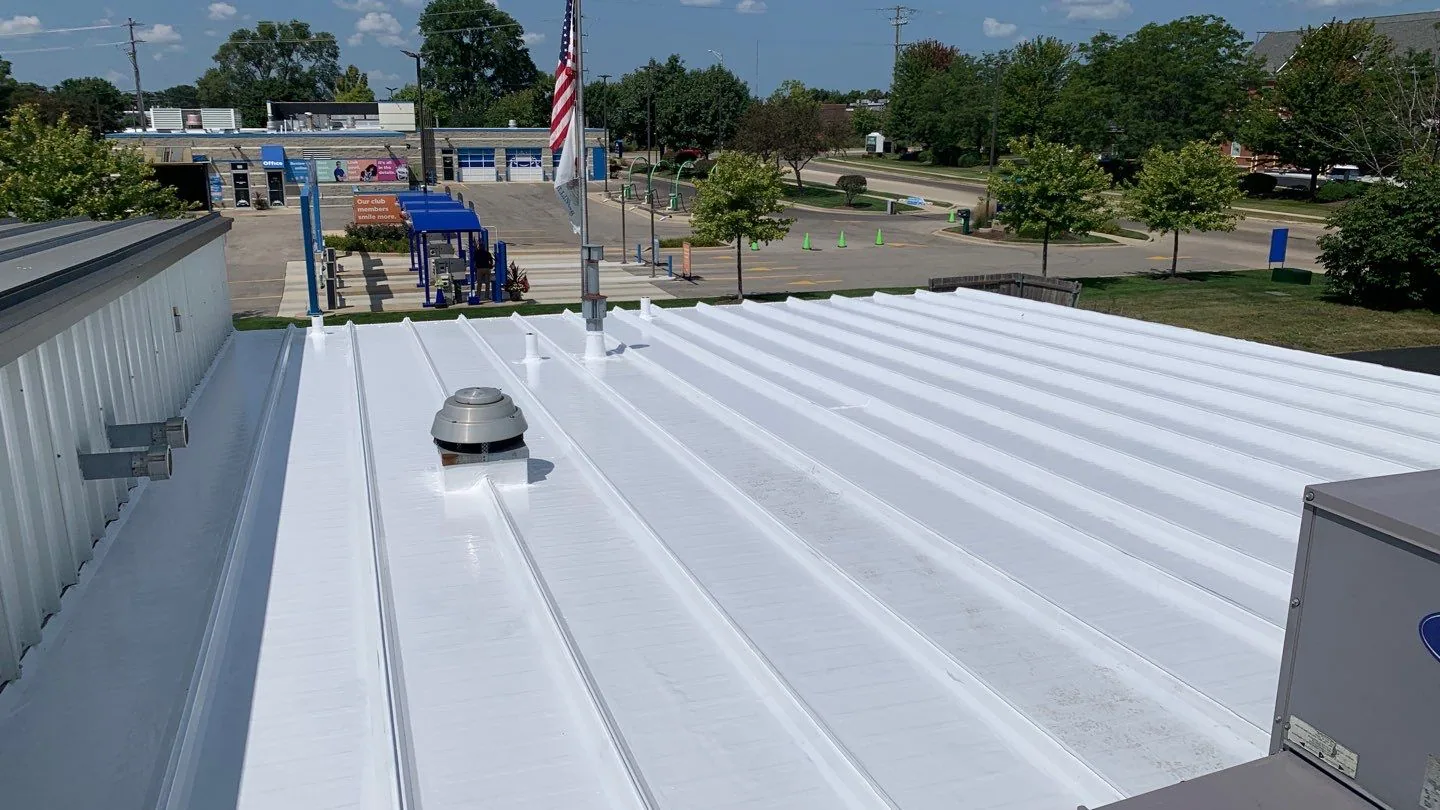
A coating restoration suits a roof whose membrane is worn but whose insulation and deck are still sound. In Nampa, ID, that describes a low-slope roof that has weathered years of summer UV and winter freeze-thaw but has not yet let water into the assembly. The work extends service life by sealing the surface, reflecting heat, and covering seams, without the debris and disruption of tear-off.
Eligibility Findings
Three conditions decide whether a roof can be coated. The insulation must read dry across a grid of moisture readings, confirmed with core cuts at suspect points, because coating over wet insulation seals the water in. The membrane must be intact enough to bond, with seams still attached and no widespread splits. And the surface must accept the coating, which the adhesion test shows directly.
Roofs that fail the first test are not candidates, and we say so in writing with the moisture map attached. Wet areas can sometimes be cut out and replaced before coating, but when wet insulation is widespread the better path is usually a recover or a replacement. The findings in the record list each roof section as eligible, conditional, or not eligible, with the reading that placed it there.
Coating Systems and Surfaces
The coating type follows the substrate and the water pattern on the roof. Silicone coatings tolerate ponding water and bond to many aged surfaces, which suits low areas that cannot be corrected. Acrylic coatings reflect heat well and cost less to apply, but they are not meant to sit under standing water, so they suit roofs that drain. Polyurethane and other liquid-applied systems appear on some scopes where abrasion or foot traffic is the concern.
Surface preparation differs by existing membrane. A TPO or PVC surface needs cleaning and a compatible primer. An aged modified bitumen cap sheet needs granule treatment and often a base coat. A metal roof needs rust treatment, fastener sealing, and seam reinforcement before the topcoat. The scope names the prep step for every section, since prep is where most coating failures begin.
Seams, Flashings, and Reinforcement
A coating is only as continuous as the details beneath it. Open seams are sealed and reinforced with fabric before the field coat goes on. Pipe penetrations, curbs, and wall flashings are detailed with reinforced mastic or liquid flashing resin, and failed terminations are removed and reset instead of coated over. Drains are cleaned and sealed at the rim so the coating does not leave a gap where water can run beneath it.
On an industrial roof in North Nampa, where the north quadrant plan describes industrial tracts near I-84, a restoration scope can spend more labor on penetrations than on the field. Exhaust stacks, conduit, and equipment supports each get a photographed detail. The spray foam alternative is also considered where the roof needs added insulation value along with a new surface.
Application Windows
Coatings cure in dry conditions with surface temperatures inside the product's range, and a rain shower or cold night during cure can ruin a day's work. Nampa's semi-arid warm season gives long dry stretches that suit application, and the wet months run November through May. We schedule coating work in the dry months and record the surface temperature, the humidity, and the forecast at the start of each day.
Winter design conditions matter after the work as well. Nampa's winter design temperature is 10 degrees Fahrenheit, and snow load is part of the same design picture. A fully cured coating handles freeze-thaw movement, but a coating applied too late in autumn may not reach full cure before the first cold snap, which is why the autumn cutoff is written into the schedule.
Walkways and Equipment Areas
Rooftop traffic wears a coating faster than weather does. Paths between access hatches and equipment, the area around a service door, and the ground beneath a condenser all see repeated foot loads, and a thin film at those points abrades first. The scope identifies those paths on the roof plan and adds walkway pads or a heavier film so maintenance staff can reach equipment without cutting through the finish.
Equipment that drips condensate, grease, or chemical exhaust also affects the surface. A kitchen exhaust fan or a refrigeration unit may need a splash pad or a curb extension so what falls on the roof is channeled away. These small additions are photographed and listed with the rest of the details, and they keep a restored roof from being damaged by the building it covers.
Closeout File
At completion the file holds the moisture map, the adhesion test photographs, the prep record for each section, the coating batch information, the measured film thickness at test points, and the finished photo sequence. The thickness readings matter because coating performance depends on the applied film, not on the number of coats listed in a quote. Where a manufacturer warranty is involved, the file also supports the warranty paperwork with the installation evidence the manufacturer asks for.
A restoration is also scheduled for its next review. The file states when the first inspection should occur and what to look for, such as ponding at low areas or wear at traffic paths, so the coating enters the maintenance routine with a defined starting condition.
Questions
How long can a coating extend a roof's service life?
The extension depends on the starting condition, the system, and the film thickness applied, so a number would be a guess. The record states what each section looked like at the start and when to review it, which gives the owner a measured basis for planning the next capital step.
Can a coating fix an active leak?
A coating seals the surface and many small openings, but a leak that comes from wet insulation, a failed flashing, or a deck problem needs repair first. We trace the source, repair it, and then coat. Coating over an unresolved leak hides it without stopping it.
Which is better for a roof that ponds, silicone or acrylic?
Silicone tolerates standing water, so it is the usual choice where ponding cannot be corrected. Acrylic is meant for roofs that drain. If the ponding comes from a drain that can be raised or added, correcting the drainage first may open both options.
What does coating do for energy use in a Nampa summer?
A reflective coating lowers the roof surface temperature, which reduces heat gain into the space below. The size of the saving depends on the insulation, the building use, and the cooling equipment, so we describe the effect qualitatively and leave dollar claims out of the record.
Does a coating change how the roof must be maintained?
Yes, in a few ways. Foot traffic paths should be protected, drains kept clear, and the film inspected for wear at low areas. Those checks become part of the maintenance visits listed in the preventive program.